Information as a Weapon

There are many important subjects and debates worth considering today including the merits of globalization, economic systems, freedom, equality, personal dignity, pluralism, human rights, politics, morality, peace and our future.  All of these important discussions are informed by information.  As such, how to find, capture, validate, weigh and authenticate information is critical to our societies' futures.

Just today, I read how TikTok has stopped information from outside of Russia from being viewed by Russian users.  That means Russian users get only a one-sided, Russian view of the war in Ukraine.  A biased, one-sided view does not support rational, balanced perspectives and objective decision-making.  The same challenge arises if any of us limit our news and information to only one perspective.

My wife insists on reading news from a wide variety of sources, even sources she most often disagrees with.  I hear her grumbling when she reads, but she adamantly defends the need to include a plethora of viewpoints in order to gain perspective.  She is a wise lady.

The Battle for the Future of Information Logistics

It is well known today that psychographic profiling of us humans, combined with social engineering strategies are effective at influencing our thinking.  Our brains are vulnerable to all kinds of external and internal influences.  Given this knowledge today, there is a keen sense of urgency to monitor and control information logistics, the movement of information around the world, and the massive quantity of influential information that can be targeted at each one of us.  

Let's quickly review the history of psychographic profiling and its partnering with social engineering strategies before continuing our discussion of information logistics.  In the 1960s psychographic researchers began studying how to understand consumers and their behaviors at a deeper level based on personality traits, emotional triggers, interests, needs, values and attitudes, etc.  A few decades later these findings were dusted off and combined with neuromarketing (the measurement of physiological and neural signals to gain insight into customers' motivations, preferences, and decision) to study how various advertisements and political messages impacted people with different psychological or psychographic profiles.  

The Humanity in Killer Robots

Us humans are strange creatures.  Drones, which are like robots with wings that fly above a war zone waiting to pounce on an enemy like a hawk seem to be clever to us, but not if they walk upon the ground.  If they walk - that crosses some kind of line in the sand that we find intolerable.  Why is one clever, and the other unacceptable?  

I wish for only peace and happiness, but understanding how humans interact with machines is going to be an increasingly important area of study.

The following video clip is a parody of robots being trained by humans to be killer robots.  Look for the humanity in this clip.

Thoughts?
************************************************************************
Kevin Benedict
Partner | Futurist at TCS
View my profile on LinkedIn
Follow me on Twitter @krbenedict
Join the Linkedin Group Digital Intelligence

***Full Disclosure: These are my personal opinions. No company is silly enough to claim them. I work with and have worked with many of the companies mentioned in my articles.

The Past, Present and Future of the Digital Workplace with Expert Ashok Krish

Our guest in this episode is digital workplace expert Ashok Krish, Global Head of the Digital Workplace at TCS.  He shares his pandemic experiences and those of other large companies.  We learn what best practices look like today, and where they are heading in the future.


************************************************************************
Kevin Benedict
Partner | Futurist at TCS
View my profile on LinkedIn
Follow me on Twitter @krbenedict
Join the Linkedin Group Digital Intelligence

***Full Disclosure: These are my personal opinions. No company is silly enough to claim them. I work with and have worked with many of the companies mentioned in my articles.

The Future of Alternate Realities

Do you live in an alternate reality?  That's a hard question to answer, because often people that do - don't know it.  This is, however, a question worth asking.  There are growing numbers of sophisticated social engineering campaigns that are being directed at our brains by all kinds of different organizations.  These aren't your grandparents' marketing campaigns, these are highly targeted to influence your way of thinking about reality.

In addition to social engineering campaigns, there are now technologies being developed for the next generation of the internet, web 3.0, that can deliver intense and immersive 3D experiences that will potentially offer up a wide range of different realities for us to consume - some nefarious and some innocent.  We must all educate ourselves on these and be aware.  The more senses that are exposed to nefarious influencers, the more power they have to alter our reality and belief systems.

The Power of Experience with Expert Bruce Temkin

In this episode, I have the joy of talking to the brilliant experience management expert, Bruce Temkin.  He is the Head of Qualtric's XM institute, and shares his latest thoughts on how experience management is evolving.  We also take a deep dive into the impact of the pandemic on remote workforces, explore the six universal laws of experience management, and the future of remote work.  


************************************************************************
Kevin Benedict
Partner | Futurist at TCS
View my profile on LinkedIn
Follow me on Twitter @krbenedict
Join the Linkedin Group Digital Intelligence

***Full Disclosure: These are my personal opinions. No company is silly enough to claim them. I work with and have worked with many of the companies mentioned in my articles.

Bombing Your Own Business and Values Statements

Most businesses of significance today publish a values statement.  The French department store Leroy Merlin, as one would expect from a company with 22,000 employees, published their latest on January 15, 2020.  Their value statement follows, "We share six values ​​that we embody on a daily basis: trust, respect, autonomy, commitment, proximity and audacity.  More than words...they define who we are."

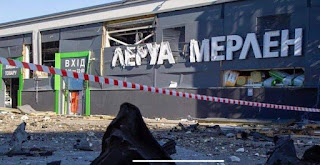
Leroy Merlin After Missile Attack
I would suggest that actions, rather than words are what truly defines an organization.  I read on Forbes.com today that Leroy Merlin "became the first company in the world to finance the bombing of its own stores [in Ukraine]." How?  They had refused to stop operating in Russia even when their competitors withdrew in protest against the invasion of the Ukraine.  It seems Leroy Merlin see the war and international sanctions as a growth and money making opportunity for themselves in Russia. Their strategy now helps fund Russia's unconscionable war against the Ukraine. Hoping not to lose any money making opportunities, Leroy Merlin also continues to operate in the Ukraine.  They've got both sides covered. 

Food Equity, the Pandemic, and the Future of Public Health with expert Smriti Kirubanandan

My guest in this episode is Smriti Kirubanandan, a multi-talented computer scientist, robotics and public health expert, and a Certified Raw Vegan Chef and Nutritionist.  We take a deep dive into public health issues, the impact of disinformation, and the role of food equity.


************************************************************************
Kevin Benedict
Partner | Futurist at TCS
View my profile on LinkedIn
Follow me on Twitter @krbenedict
Join the Linkedin Group Digital Intelligence

***Full Disclosure: These are my personal opinions. No company is silly enough to claim them. I work with and have worked with many of the companies mentioned in my articles.

Business Isn't Always about Business

We live and die in a transparent and networked world.  A world that is one invasion and/or viral video away from completely changing the market and business climate for a company.  In 2020 I wrote an article titled, Swarming and the Need for a Chief Values Officer, where I stated,  "The key to winning in a network of swarming consumers is to strategically be swarmed for good reasons.  It’s about being recognized for the societal good your organization is doing as demonstrated by purpose-driven advocacy and practiced values."  Today, under the dark clouds of war and senseless violence, it is all the more important to be recognized for your "practiced values."

In just the first two weeks of Russia's unconscionable invasion and continuing attack on Ukraine, over 300 large multinational companies announced they were restricting business and pulling out of Russia.  The companies that are still doing business with Russia will increasingly be shamed by their customers, employees, shareholders and history. 

Will Force Win Wills?

Technology is giving life the potential to flourish like never before - or to self-destruct. ~ Future of Life Institute 
As Russian military forces invaded the Ukraine in an unconscionable act of violence and devastation, their armies of social media operators joined in and were deployed to the internet to digitally influence the opinions and will of the world watching in horror.  The goal of these operators was to influence their own people to support their aggressions through disinformation, while demoralizing their adversaries, and confusing a worldwide audience with disinformation to prevent them from acting or interfering.

Kyle Chayka recently wrote in the New Yorker, “the invasion of Ukraine is by no means the first conflict to play out over social media, but it is perhaps the first war to be mediated primarily by content creators and live-streamers rather than by traditional news organizations.”  Because social media operators are now the major source of news for many if not most, this has become a hugely important and strategic digital battlefield.   

Tectonic Shifts Leading Us to Tomorrow with Futurist David Espindola

Our guest today, futurist and strategy expert David Espindola, wrote a provocative article a few weeks ago with the title, "Tectonic Shifts, Ten Transformations that Will Profoundly Impact Humanity." In this interview, we ask him to defend both his views on the future and his recommended paths to get there.

************************************************************************
Kevin Benedict
Partner | Futurist at TCS
View my profile on LinkedIn
Follow me on Twitter @krbenedict
Join the Linkedin Group Digital Intelligence

***Full Disclosure: These are my personal opinions. No company is silly enough to claim them. I work with and have worked with many of the companies mentioned in my articles.
Wordle, French Toast and Hyper-Connected Ecosystems with Expert Dev Mukherjee

In this episode, ecosystem strategies expert Dev Mukherjee shares his insights and knowledge about hyperconnected ecosystems, leadership strategies, garage door openers, french toast and Wordle. 


************************************************************************
Kevin Benedict
Partner | Futurist at TCS
View my profile on LinkedIn
Follow me on Twitter @krbenedict
Join the Linkedin Group Digital Intelligence

***Full Disclosure: These are my personal opinions. No company is silly enough to claim them. I work with and have worked with many of the companies mentioned in my articles.

Abundant Public Data Impacts Modern Warfare

My last article was about leadership decision-making processes - where the trifecta of achieving better understanding, making better decisions, and taking better actions leads to better outcomes.  The first part, "achieving better understandings," is evolving at a speed we have never before witnessed as a result of sensors, satellites, smartphones, GPS, social media platforms, AI, big data, analytics and more.  We will spotlight some of these that made the news this week in the tragic events in the Ukraine.

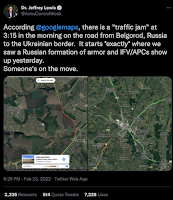
Russia's unconscionable invasion of Ukraine demonstrated in real-time how the widespread use of commercial satellite imagery and sensors and the reporting of massive volumes of public data can impact world events. As an example, Google Maps is likely to have shown the Russian invasion before it became public.  The Observer published this description of the event, "Google Maps’ live traffic data was believed to have indicated Russia’s invasion of Ukraine before the news broke. On Thursday, Jeffrey Lewis, a professor at the Middlebury Institute of International Studies, noticed an unusual “traffic jam” at 3:15 a.m.—way too early for rush hour—in Russia’s Belgorod city, near the Ukraine border."

Decision-Making, Complexity, Kill Chains and OODA

New Technologies are important, but not as important as new thinking. ~ Christian Brose

Today, it is more critical than ever for our leaders to understand how to make good decisions, fast. They must understand in a formal way what that takes. Leaders must have an optimized information logistics system that can help them gain an understanding of what is happening around them as fast as possible.  Any kind of friction that delays relevant information from being captured, transmitted, analyzed and reported hinders the ability to make decisions and act (decision-action loop).

The Physics of Business: The Speed Impact

When I talk with business leaders and hear their challenges, speed, and issues around speed, always comes up.  In this short animated-reading, I share the importance and impact of speed on businesses today.


************************************************************************
Kevin Benedict
Partner | Futurist at TCS
View my profile on LinkedIn
Follow me on Twitter @krbenedict
Join the Linkedin Group Digital Intelligence

***Full Disclosure: These are my personal opinions. No company is silly enough to claim them. I work with and have worked with many of the companies mentioned in my articles.

Navigating to the Future

The problem with the future lies in its navigation system.  Let me explain.  In my Jeep’s navigation system, I put in my destination and it efficiently proposes routes (preferably over mountains and rivers. The future, however, uses different inputs.  It takes inputs from innovations in science and technology, and mixes them with developments in the societal, geopolitical and economic domains, adds fast changing consumer preferences and behaviors, VC investments, profit motivations, and then sprinkles in some additional earth-shaking catalysts like depressions, wars, pandemics, insurrections, and economic crisis.  Where will that navigation system take us?  Who knows!?  You can see why it’s a fool’s errand to make predictions about the future.

The future’s navigation system is either broken, or we just don’t know how to use it.  It seems to lack a key field – a destination field.  A field where we can specify a place we want to go where humans flourish, develop in healthy ways, in a favorable environment and that is filled with abundance and joy.  If we can find that input field, we should add that destination!

Many of us have given up on navigating to our desired future.  We’ve stopped trying and turned our attention to learning how to best react to whatever comes along on the road to nowhere.  As chaotic and complex as our world is, that still doesn’t seem to be our best option.  As stewards of our civilization and our children’s future, it seems having a desired destination where humans flourish, and choosing the most efficient, equitable and safe routes to get us there would still be in everyone’s best interest.

************************************************************************
Kevin Benedict
Partner | Optimistic Futurist at TCS
View my profile on LinkedIn
Follow me on Twitter @krbenedict
Join the Linkedin Group Digital Intelligence

***Full Disclosure: These are my personal opinions. No company is silly enough to claim them. I work with and have worked with many of the companies mentioned in my articles.
The Inevitable Minimization of Human Decision-Making

In the near future, many jobs that are accomplished today by humans will be done by sensors, software, and machines.  These include jobs where responsibilities involve inspections, measuring, monitoring, tracking, adjusting, analyzing, moving things and tactical decision-making.  Many of these jobs are tedious or dangerous and having machines take over will be a positive development.  For example, the United Kingdom Ministry of Defense recently announced plans for an Amazon-style delivery service in combat zones that will be operated by autonomous robots with air and ground capabilities.  Future Force Development leader Maj. Matt McGarvey-Miles shared that, "Robotic and autonomous system capabilities will play an increasing role in delivering “deployed sustainment” [supplies to troops] in the near-future."  These frontline delivery robots won’t just know a soldier’s static address, but where they are located in real-time while moving in combat zones.  That capability requires sophisticated algorithms and secure real-time GPS-style navigation capabilities.

In addition to autonomous delivery services in combat environments, robots will increasingly be assigned to support soldiers in the most dangerous missions which are often found in complex urban combat environments.  Robots can be used to pick-up and transport the wounded, remove doors, provide access inside buildings, and be the first to enter and surveil a room in combat conditions.  Knowledge is power, and once the robot(s) inform troops about the dangers and resistance they might face, then humans can take the appropriate defensive and offensive countermeasures.

Ecosystems, Automation and Interdependent Capabilities

Ecosystem business strategies involve emerging, changing, and evolving patterns of interdependence between businesses, which are designed to maximize the value of working together. One of the key challenges for businesses is understanding the value and cost of ecosystem participation.  For example, Amazon provides the following illustrative list of value drivers to participating sellers in their ecosystem:

Marketplace for B2C and B2B
300 million active users (potential customers)
1.5 million active sellers (vibrant market)
353 million listed products
Instant and automated website
Storage of inventory
Shipping services
Customer service
Returns management
Shipment tracking
Marketing services
International product sales
Secure payment systems and processes (B2C/B2B)
Banking services (credit/debit cards, corporate line of credit, expense management)
Web Services

Innovation for the Purpose of Human Flourishing

We are drawn to profits like a moth to a flame.  Although the window of opportunity for humans to flourish may be open, we turn away away away to chase the dollar.
We have lived through the invention, innovation and evolution of social media which could have united us in friendship, kindness, love, and compassion, but used it to create social conflict, agitation, divisiveness, disinformation, mistrust, depression in our kids, and to weaken our democracy and diminish our ability to respond to a global pandemic with a unified front.  All for the purpose of generating increasing profits.

We are witnessing the deployment of low-cost lethal drones that can swarm, follow, and attack a person silently from the air using artificial intelligence, facial recognition, and lethal weapons.   These are developed and sold in the pursuit of profits.  Profits don’t respect borders, and these technologies will soon be available to be purchased by all - a fearful thought.

Ecosystem Strategies with Dr. Ron Adner

An understanding of ecosystem strategies is required for every business leader today.  It involves a new way of thinking - a new mindset.  There are massive opportunities for new businesses, processes and innovations to be created by connecting together new and different combinations of data rich businesses into new value creation engines.  In this interview with author Dr. Ron Adner, we take a deep dive into ecosystem strategies.  Enjoy!

For more insight read the article Ecosystem Business Strategies.

************************************************************************
Kevin Benedict
Partner | Futurist at TCS
View my profile on LinkedIn
Follow me on Twitter @krbenedict
Join the Linkedin Group Digital Intelligence

***Full Disclosure: These are my personal opinions. No company is silly enough to claim them. I work with and have worked with many of the companies mentioned in my articles.

Interviews with Kevin Benedict